
Compare Lawrence County Deed Types
A deed's label signals what kind of transfer happened. The full instrument still controls. Lawrence County deed records include ordinary voluntary conveyances, fiduciary transfers, and court or tax-driven deeds. The Clerk's permanent record universe also holds mortgages, releases, mineral leases, liens, lis pendens, plats, and anything else that touches the same tract.
| Deed Type | Effect on the Record | Typical Context |
|---|---|---|
| Warranty deed | Conveys the stated interest with title covenants | Many ordinary sales |
| Quitclaim deed | Conveys whatever interest the signer has, if any | Family or title cleanup |
| Special warranty deed | Uses limited covenants | Some business or estate transfers |
| Executor or commissioner deed | Conveys under fiduciary or court authority | Estate and judicial sales |
| Sheriff's deed | Records a transfer from an official sale | Tax or court process |
A mortgage or lien is not a deed. It can burden title without conveying ownership the way a deed does. Search releases and satisfactions beside the original encumbrance, then match every reference to the parties and the legal description before drawing conclusions.
Lawrence County's Deed Recorder
Kentucky assigns Lawrence County land records to the County Clerk, not a separately elected recorder. Clerk Chris Jobe keeps the deed books and related instruments at 122 South Main Cross Street in Louisa. The office phone is (606) 638-4108. General hours run 8:30 a.m. to 4:30 p.m. weekdays, and the first Saturday is open 8:30 a.m. to noon. The Clerk's land-record page offers recording and document guidance for filers. It publishes no county-specific online index or deed-image access. The counter is therefore the primary channel for Lawrence County deed records. Ask there for the land-record index. Bring every known spelling, an approximate year, and any book or page clue you have. The staff can pull the index volumes once you narrow the search.
A missing web form is not a gap in the legal record. Kentucky retention rules treat deed books and grantor/grantee indexes as permanent, so the paper trail survives regardless of what appears online.
Search Lawrence County's Grantor-Grantee Index
KRS 382.200 requires an alphabetical cross-index. Grantees appear on one side. Grantors, meaning anyone who conveyed or acted on an interest, appear on the other. Start with the newest reliable owner of record. Move back one source-of-title reference at a time. Never jump from a surname match straight to a title conclusion.
- Obtain the current assessment owner and source-deed clue from the PVA.
- Search that owner as grantee and retrieve the acquisition deed.
- Copy the grantor, recording date, book/page, legal description, and prior source reference.
- Search the named grantor as an earlier grantee, then repeat the checks.
- Search the grantor side for outgoing deeds, mortgages, releases, leases, and liens.
- Grantor
- The party transferring or acting upon the interest.
- Grantee
- The party receiving the interest.
- Chain of title
- The ordered series of instruments connecting ownership through time.
- Book/page or instrument number
- The Clerk's citation used to retrieve a recorded document.
Read Lawrence County Deed Records
Lawrence County publishes no local sample result. Exact screen labels and image links cannot be promised. The Kentucky statutory and retention system still supports a practical capture list. Copy every data point exactly, including punctuation and role labels. That precision lets the next index search reproduce the result.
| Index or Deed Field | Research Use | Check |
|---|---|---|
| Grantor and grantee | Connects the transfer parties | Search both roles and spelling variants |
| Recording date and deed type | Places the instrument in sequence | Do not substitute signing date |
| Book/page or instrument number | Retrieves the source document | Confirm the exact Clerk citation |
| Legal description | Matches the conveyed tract | Compare calls, acreage, lot, and source deed |
| Consideration statement | Supplies a transfer-value clue | May not equal market value |
| Source of title | Points backward to an earlier deed | Retrieve the cited instrument |
KRS 382.135 governs consideration or market-value statements and mailing information, subject to exceptions. A nominal, gift, estate, or related-party transfer may show a figure far below market value. Treat the acknowledgment, preparation statement, and return address as supporting details. Never use them as substitutes for the granting clause. If a release cites an earlier mortgage, pull both instruments. Confirm that the parties, land, and original book and page all agree. When a deed cites a plat, inspect the recorded plat itself. Do not rely on a lot label copied into a later assessment card.
Lawrence Deeds Through Heirs and Officials
A clean buyer-to-seller chain can break. Land may pass through an estate, court action, or official sale. Search the decedent and the executor or administrator. Try "heirs" wherever the index uses that role. A commissioner or sheriff may appear as grantor even though neither held the beneficial interest. Trusts and entities demand their exact recorded names too. The Kentucky Department for Libraries and Archives deed guide suggests trying index letters for heirs, commissioner, and sheriff. Do this when a surname search fails. Follow an affidavit of descent, will, estate settlement, court order, commissioner deed, or sheriff deed. Each one leads to the next recorded link. CourtNet and the Lawrence Circuit Clerk can supply the case trail. Turn there when a deed cites litigation.
Lawrence County's Permanent Deed Books
Lawrence County was carved from Greenup and Floyd counties in 1822. A chain reaching earlier needs predecessor-county work. The first local deed book and the imaging cutoff stay unconfirmed. No courthouse fire or lost deed decade is documented. A missing web result is not proof of a destroyed record.
Deeds from about 1890 forward usually cite an earlier book and page. That citation lets you reverse-chain a tract. Earlier hunting may lean on tax lists to place an owner before a conveyance. The Clerk's bound books carry the legal record. Indexes there anchor every chain. KDLA can help with transferred archival material. The Lawrence County Public Library's genealogy collections add newspaper clues. They add local-history clues when the paper trail thins.
Note: Test predecessor county, spelling, index role, instrument type, and fiduciary name. Do this before declaring any link in a Lawrence County deed chain missing.
The Lawrence County Public Library offers another route. It helps when deed books yield only a name or a place clue. Its Big Sandy News collection starts in 1885. Digitization work carries it nearly to the present. Search an old owner, farm, branch, estate sale, commissioner notice, or road name. Then return to the Clerk's index to confirm any transfer named in print. Print is context, not the conveyance itself.
The official Kentucky real-estate recording chapter supplies the statutory setting for the permanent deed books and indexes of Lawrence County.
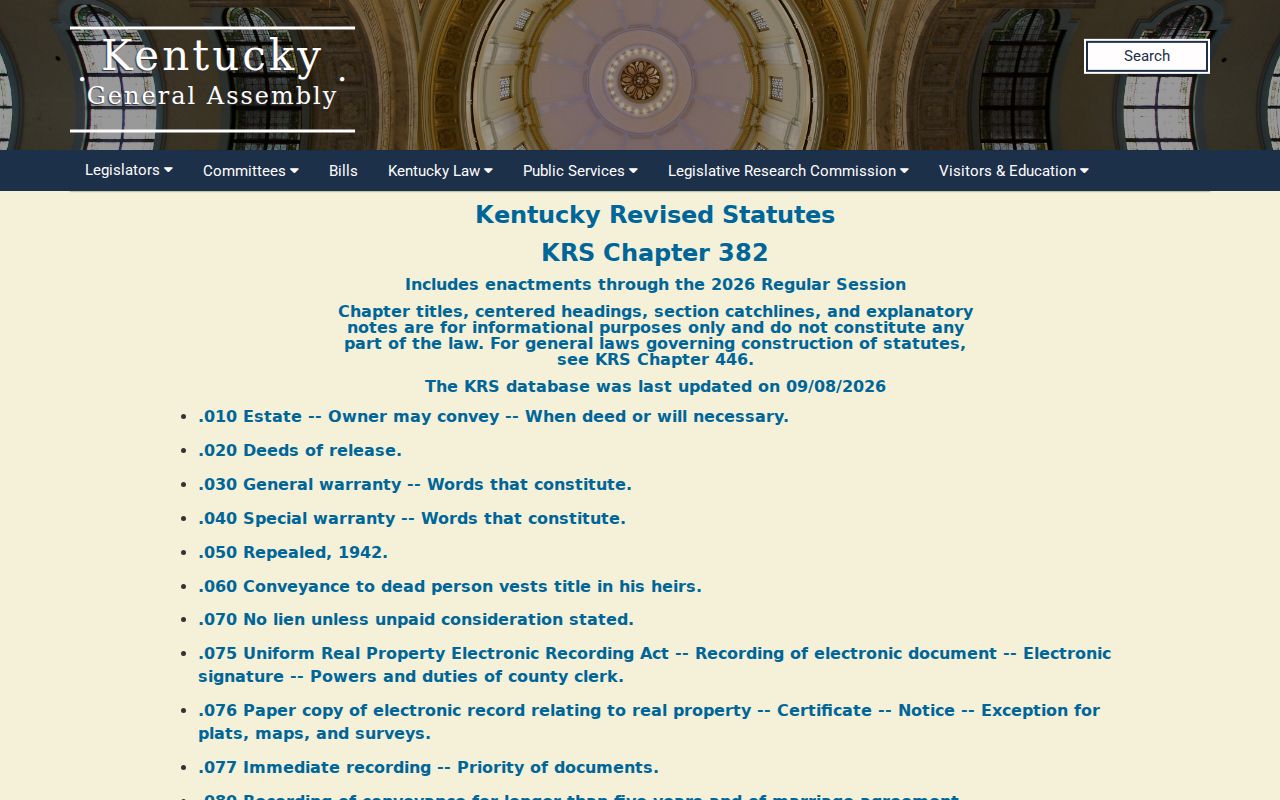
The statute page sets the recording rules. The Lawrence County Clerk still holds the actual local instrument, so every citation leads back to the counter.
Mineral Interests in Lawrence County Deeds
Local history records oil's arrival at Berea, south of Louisa, in 1910. Hundreds of wells followed. An oil-dominant stretch ran from 1920 through 1922. That history adds one extra question to Lawrence County deed research: did the deed reserve minerals, or did a separate lease or assignment touch the tract?
Search mineral leases, severances, royalty interests, assignments, and releases under the same owner names and parent-tract descriptions. A modern surface parcel can look simple. The recorded language still controls. An older instrument can treat oil and gas rights separately, and a current assessment card is no substitute for reading one.
Request Lawrence County Deed Copies
With a citation from the index, ask for the deed by book and page or by instrument number at the Clerk's counter. Inspection is free. Open-records rules price noncommercial written copies at ten cents per page. Commercial written copies run fifty cents per page. Nonwritten items carry actual production cost, postage is extra, and fees come due before release.
The Lawrence page publishes no complete certified land-copy schedule. Kentucky fee law sets a five-dollar certified-copy fee plus fifty cents per page after three pages. Confirm amounts and certification needs with the Clerk. An offline request should list parties, record type, date range, citation, property description, format, and a mailing address.
Written requests follow the Clerk's own rules, starting with a clear record description. Include a signature and printed name. Add a Kentucky residency statement and a commercial-use statement. Give an address when copies are requested. The office gives notice within five working days when records are unavailable or access is denied. Maps, photographs, and files carry production cost plus postage. A precise citation serves you better than a broad request for every paper tied to an address.
Recorded is not clear title. Filing gives public notice and an index trail, but it does not settle every defect, competing claim, unrecorded interest, or boundary issue.