
Read Lawrence County Property Tax Records
Three offices, three answers. A Lawrence County property tax search works best when the roles stay clear: the PVA assesses, the Sheriff bills, and the County Clerk holds delinquent certificates. The parcel number links those records. The county publishes no online tax-bill result or PVA parcel card, so calling or visiting each office is the dependable route.
| Record Field | Meaning | Custodian |
|---|---|---|
| Assessment year | Year for which the parcel value is carried | Lawrence County PVA |
| Land and improvement values | Components of the total assessment | Lawrence County PVA |
| Class or exemption | Tax treatment, including agricultural or homestead status | Lawrence County PVA |
| Current bill and payment | Amount, discount or penalty stage, and receipt status | Lawrence County Sheriff |
| Delinquent certificate | Unpaid bill transferred after the collection window | Lawrence County Clerk |
Kentucky's Department of Revenue sets the standard. The PVA assesses real property at estimated fair cash value, meaning what it would bring in a fair voluntary sale. Qualifying farmland can instead be assessed at agricultural value. Either way, the figure is an administrative tax value, not a promise of what the property would sell for.
Lawrence County Tax Offices
Chris A. Rose serves as the Lawrence County PVA and keeps the assessment roll at the courthouse, 122 South Main Cross Street, Louisa. The office can be reached at (606) 638-4743, and the state directory lists weekday hours of 8:00 a.m. to 4:00 p.m. This is the office to query for owner of record, situs, mailing address, parcel number, assessment year, land value, improvement value, total value, class, exemption, and source deed.
The Sheriff normally takes in current county property taxes. Once the statutory collection window closes, unpaid bills shift into the Lawrence County Clerk's certificate process. So a question about paying a current bill goes to the Sheriff, while a delinquent certificate or third-party purchase question goes to the Clerk. Note: the PVA's assessed value records alone cannot confirm that a tax bill was paid.
Trace a Lawrence County Tax Bill
Lawrence County hosts no online tax search form. Start with the street address. Ask the PVA for the exact map or parcel number, then carry that reference to the collecting offices by phone or in person. Write down the tax year at each step. Current and delinquent questions can sit with different custodians, so the year keeps the trail straight.
- Ask the PVA to match the address and provide the current parcel identifier and assessment fields.
- Contact the Lawrence County Sheriff for the current bill, payment status, penalty stage, and receipt.
- Confirm the class and exemptions against the PVA record rather than inferring them from the bill.
- If the bill passed the collection cutoff, ask the County Clerk for the certificate and sale-process status.
- Match taxpayer, bill number, map or parcel, amount, legal description, and any final recorded deed.
- Assessed value
- The PVA's value for the parcel under Kentucky assessment rules.
- Levy or tax rate
- The rate applied by the relevant taxing authority to calculate tax.
- Homestead exemption
- A qualifying reduction or tax treatment shown through the assessment system.
- Tax lien or certificate
- A recorded or statutory claim arising from unpaid tax, subject to the governing process.
Lawrence County's January Assessment Date
Kentucky keys its property-tax calendar to January 1. That date explains a common puzzle. A Lawrence County tax record can carry an owner or status from before a recent closing, because the roll speaks as of the first of the year. For a fresh sale, the deed is stronger. The PVA roll stays the assessment record for its stated year.
State law also sets inspection cycles. Each parcel must be physically inspected at least once every four years, and newly constructed property joins the roll every year. Even so, ask the PVA for the assessment year and any assessment history before comparing two figures.
The official Kentucky property-tax calendar sets the statewide deadlines. Check it before each stage. The PVA, Sheriff, and Clerk still hold a Lawrence parcel's live status.
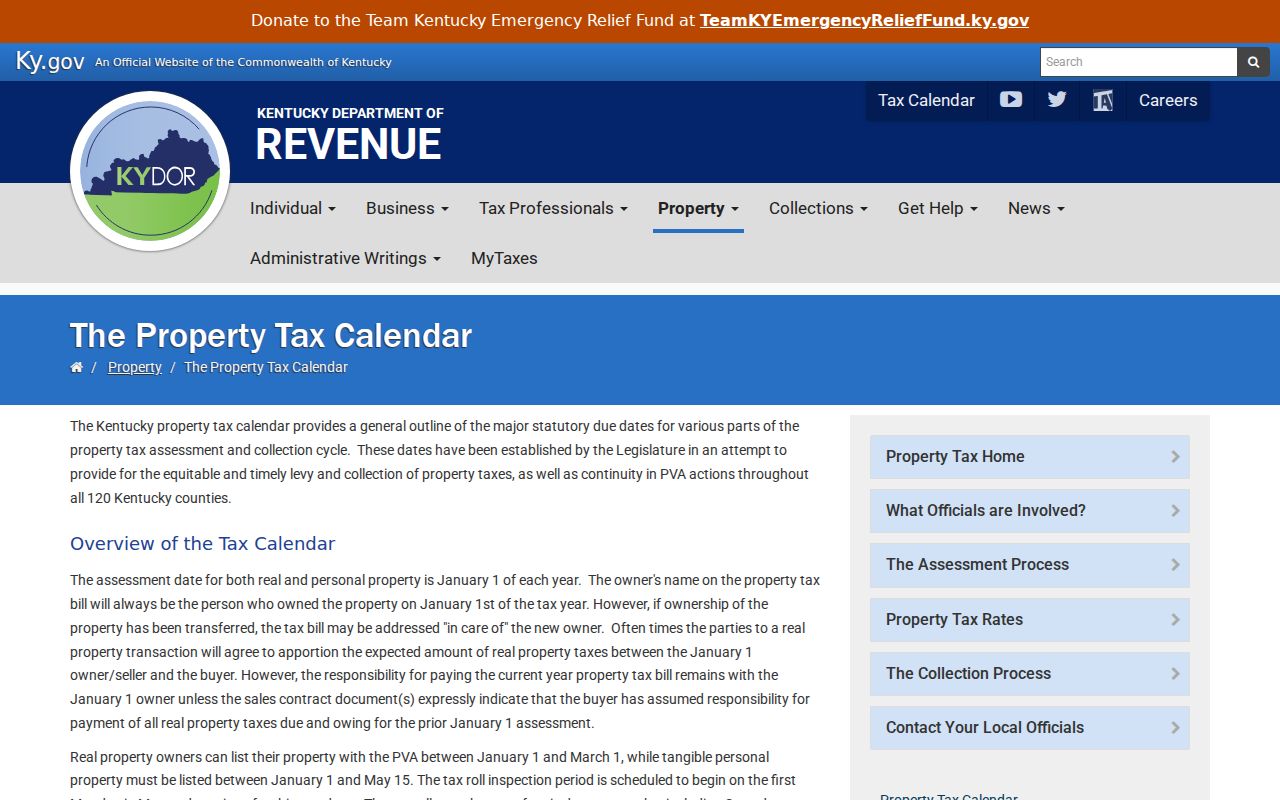
Let the calendar guide which office you call at each stage. Verify local dates before relying on them.
Lawrence County Tax Exemptions
A parcel card may list land, improvements, and total value. A class or exemption can follow. Kentucky lets qualifying farmland be assessed at agricultural value rather than fair cash value. Homestead and other exemption details should be requested from the PVA directly. The county publishes no online field guide.
Do not infer title or price from one flag. A classification is a tax fact. Ownership rests on the latest recorded deed. Ask the PVA which year and eligibility finding the displayed status reflects. That discipline keeps Lawrence County property tax records in their proper evidentiary role.
Appeal a Lawrence County Assessment
Kentucky law gives taxpayers notice and an appeal window when an assessment rises or new property is listed. The first step is a conference with the PVA. That conference must happen during the annual inspection period. If the dispute survives, the county board of assessment appeals is next under KRS 133.120. The Department of Revenue describes the inspection period as thirteen days beginning the first Monday in May, Saturdays included.
Bring the notice, parcel record, photos, measurements, recent arm's-length sales, and an appraisal if you have one. Facts about condition or classification matter too. Compare like properties at the same valuation date. Deed consideration can help. A family, estate, gift, or nominal transfer may not show fair market value.
Start during the inspection period. Contact the Lawrence County PVA promptly after notice, complete the required conference, and confirm the current filing dates and board instructions.
Keep copies of everything you present, and write down the parcel, valuation date, conference date, staff contact, and next deadline. Deed, plat, or survey issues sometimes lurk behind an acreage dispute. The appeal process never adjudicates title. Nor does it establish a surveyed boundary.
Delinquent Lawrence County Property Tax
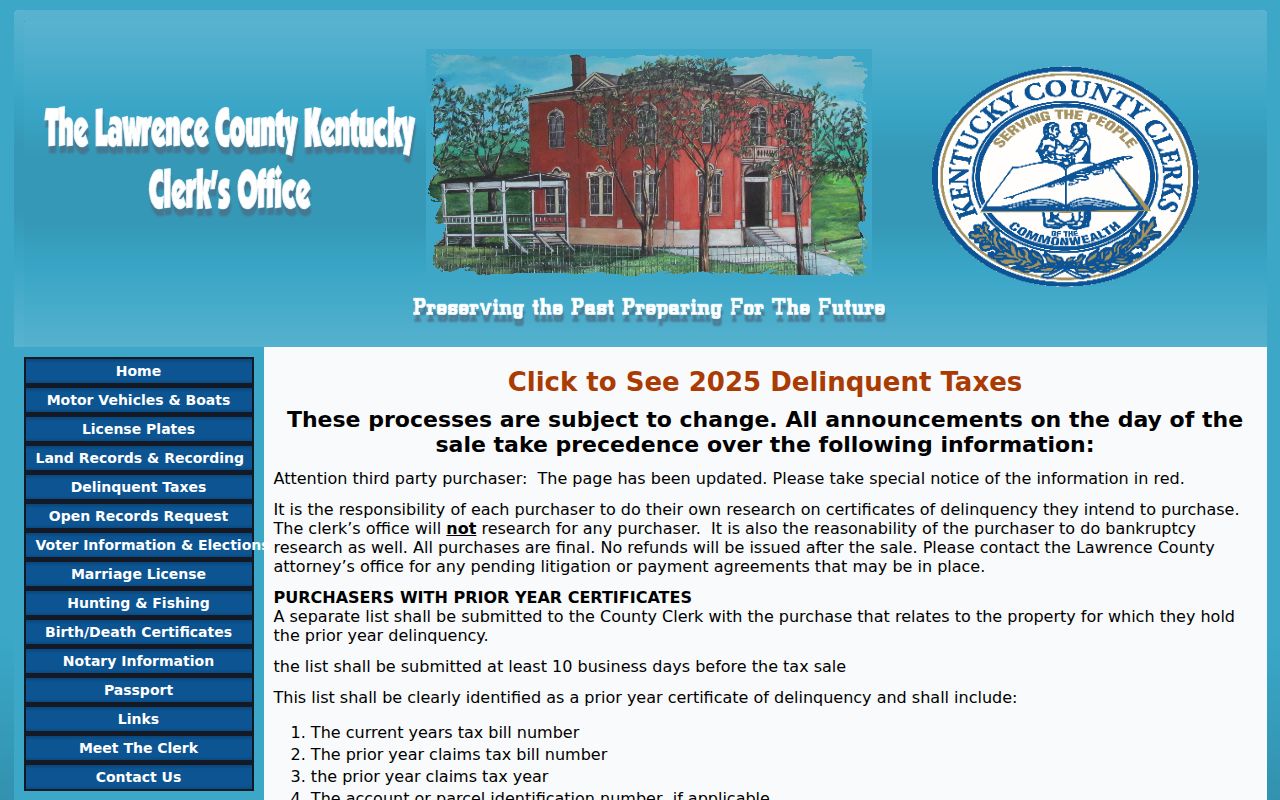
The County Clerk in Lawrence County runs the delinquent property tax sale. Its 2025 instructions say the process can change. Sale-day announcements control. Third-party purchasers must research certificates and bankruptcies on their own. Purchases are final, with no refunds after the sale.
Registration requires ten business days of lead time. A purchaser supplies contact and entity details plus an ordered bill list. The nonrefundable deposit is ten dollars per bill, capped at two hundred fifty dollars. Sale-day payment must be cash, money order, or company check. Personal checks are not accepted. A prior certificate holder submits current and prior bill and parcel data by the same deadline. This preserves preference.
The Lawrence County Clerk delinquent-tax page covers procedure only. It does not prove any named parcel is delinquent or headed to sale.
Match the bill number, taxpayer, amount, and parcel reference. Add the redemption or payment status and any bankruptcy information. Note any later court order or deed.
The 2025 Sheriff schedule placed collection in successive discount, face-value, and penalty stages, and unpaid taxes moved to the Clerk after April 15, 2026. That schedule sat on no stable official page. Verify each year's dates with the Sheriff directly. Never reuse an old penalty calendar for a new tax year.
Lawrence County Property Tax Limits
A tax record has limits. It proves no clear title. A surveyed boundary, lawful occupancy, and likely sale price sit outside it too. The owner of record on an assessment may lag a recorded closing. A current bill can be paid while another lien or court matter affects title, and a delinquent list is a notice lead rather than a final ownership conclusion.
For legal transfer or chain of title, use the Lawrence County deed guide. For value, classification, current payment, and delinquency, use the assessment and tax chain. Keep those purposes separate. Separating them prevents overreading a tax result.
Kentucky's Open Records Act covers offline records too. A written request reaches non-exempt agency records. Describe the parcel, tax year, record type, owner name, and bill or certificate number, plus the format you want. The Clerk's local rules allow free inspection and set copy charges, while another agency may apply its own lawful procedure. Take routine questions to the keeping office first.
| Question | First Office | Proof to Keep |
|---|---|---|
| Why is this value on the roll? | PVA | Parcel printout and assessment year |
| Was the current bill paid? | Sheriff | Receipt or written status |
| Did the bill become a certificate? | County Clerk | Certificate and current status |
| Did a sale change title? | County Clerk and court | Final order and recorded deed |