
Trace Lawrence County Former Owners Backward
Lawrence County publishes no online deed index. There is no cutoff date to watch for. A backward chain starts at the Lawrence County Clerk's counter with the newest recorded deed, then logs one row per transfer, matching the land description before adding any earlier owner.
| Transfer Date | Grantor to Grantee | Deed Type | Book/Page |
|---|---|---|---|
| Latest recorded transfer | Prior owner to current grantee | Copy the exact label | Record the exact citation |
| Earlier acquisition | Earlier grantor to prior owner | Warranty, quitclaim, or other | Follow the source reference |
| Chain gap | Search estate, heirs, commissioner, or sheriff | Fiduciary transfer | Check court and deed series |
Older gaps call for the record that fits the date. A deed book, reverse index, tax list, will, or estate settlement may each hold the missing link. A commissioner record may hold it too. Kentucky's retention schedule treats deed books and grantor/grantee indexes as permanent. Lawrence County has not published that range online.
Lawrence County's Clerk Holds Former-Owner Records
Kentucky gives land recording to the county clerk. The Lawrence County Clerk land-record page confirms the office's recording role. It shows no public deed-search form, no imaging date, and no local coverage cutoff. Chris Jobe's office sits at 122 South Main Cross Street in Louisa. The number is (606) 638-4108. Hours run 8:30 a.m. to 4:30 p.m. on weekdays. The first Saturday is open 8:30 a.m. to noon.
The clerk records far more than ordinary deeds. Warranty and quitclaim deeds, mortgages, releases, contracts for sale, affidavits of descent, estate papers, mineral leases, tax liens, lis pendens, plats, commissioner deeds, and sheriff deeds all sit in the same recorded universe. That breadth explains many breaks in a previous-owner list. An interest may move by commissioner deed, sheriff deed, or affidavit rather than a sale. Search the instrument that actually moved it.
The official land-record page is the verified starting point for any deed question.
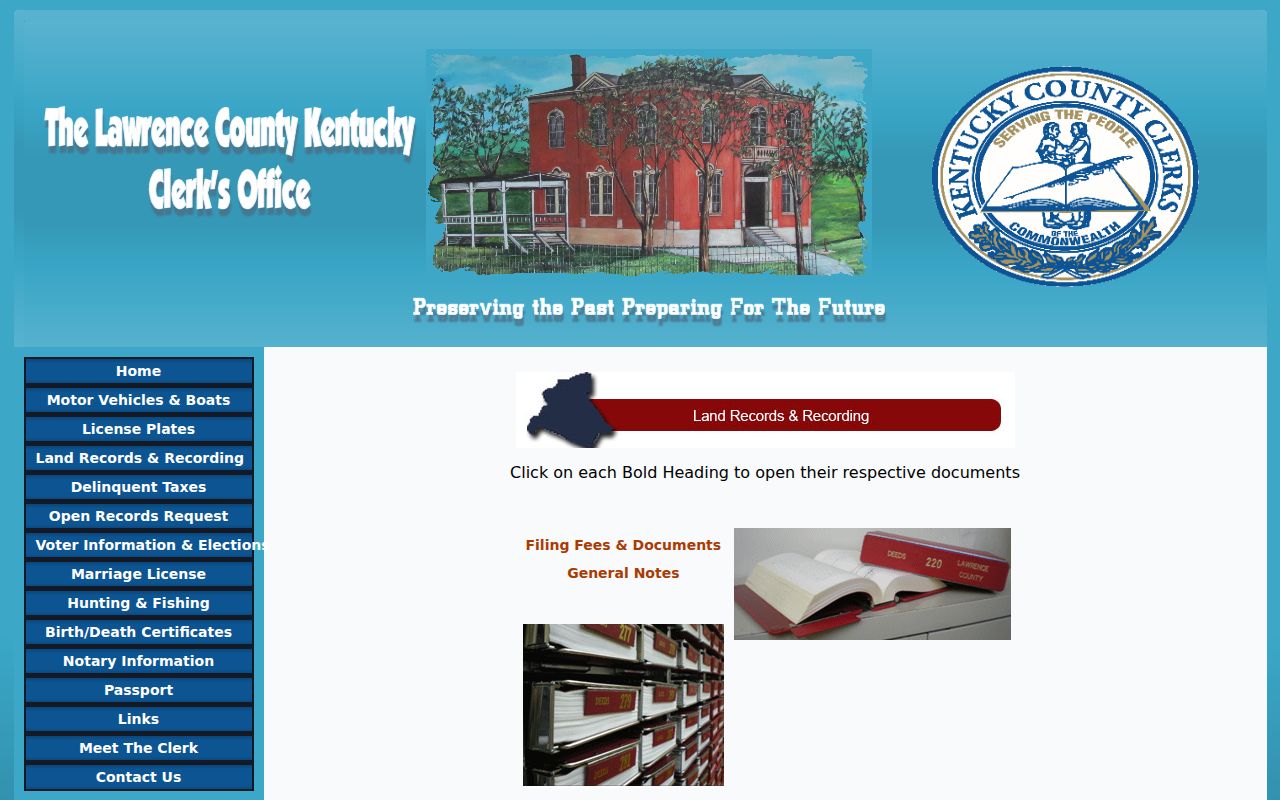
That missing deed index matters. It points the searcher to the counter, the phone, and written requests rather than an unverified third-party database.
Reconstruct Lawrence County's Deed Chain
Give every transfer its own row. Note the date, parties, deed type, book and page, and a short land-description match. The seller in one deed becomes the prior buyer. Kentucky law requires an alphabetical cross-index, but spelling, initials, trusts, and fiduciary titles still demand care.
- Get the current PVA owner lead, then ask the Clerk for that party's acquisition deed as grantee.
- Copy the grantor's name, execution and recording dates, instrument type, book/page, and source-of-title reference.
- Search that grantor as a grantee in an earlier period, checking name variants and joint owners.
- Compare legal descriptions before accepting the match, then continue in bound indexes or archived copies when needed.
- Grantor and grantee
- The grantor conveys an interest; the grantee receives it.
- Chain of title
- The ordered sequence of recorded transfers affecting the same land.
- Reverse index
- An index organized from the receiving party's side, useful for finding an acquisition.
- Quitclaim and warranty deed
- A quitclaim conveys whatever interest exists; a warranty deed carries stated title promises.
Sources for Lawrence County Previous Owners
Treat the sources separately. Each fills a different part of a research ledger, and none doubles as a ready-made owner list.
| Source | Name Clue | Record Type | Where Held |
|---|---|---|---|
| Grantor/grantee index | Indexed parties | Instrument reference | Lawrence County Clerk |
| Permanent deed book | Transfer terms | Recorded conveyance | Clerk or KDLA |
| Tax or probate record | Names around a gap | Assessment or fiduciary clue | KDLA, Clerk, or court |
A consideration statement is context, not proof. It rarely shows an open-market price. Family transfers, nominal consideration, estate distributions, and partial interests can all sit inside the same chain.
Find Lawrence County Owners Under Fiduciaries
KDLA's deed research guidance offers a clever index trick. Check "H" for heirs, "C" for commissioner, and "S" for sheriff. A surname trail often vanishes there. An affidavit of descent, will, estate settlement, partition case, foreclosure, or court-ordered deed can move an interest without ordinary buyer-and-seller wording.
Court files matter too. The Lawrence Circuit Court Clerk sits at the Judicial Center, 29 River Bend Road, and routes requests for foreclosure, partition, quiet-title, and probate files. CourtNet can offer a lead within its guest coverage. The clerk's file remains the official source. Once a case names the parties or sale, return to the County Clerk. Ask for the recorded instrument that joined the land chain.
Trace Lawrence County Owners by Landmarks
A current address is often the weakest key in an old Lawrence County deed. Rural descriptions point to landforms instead. They may name a branch, fork, hollow, ridge, route, adjoining owner, or parent tract. Big Sandy, Levisa Fork, Lick Creek, Fulkerson Branch, Meadowbrook, US 23, and KY 3 all work as search terms when a road label fails. Keep the original spelling beside any normalized address.
Louisa annexations matter too. City boundaries shifted through filings in the 1980s and 1990s and a 2012 tract along KY 3 and both sides of US 23. The same tract may carry an old county-community description. It may also carry a newer Louisa mailing label.
Mineral Records Split Lawrence County Ownership
Oil rewrote land ownership here. Local accounts put Berea oil south of Louisa in 1910. Hundreds of wells followed. An oil-centered stretch ran from 1920 to 1922. That history makes mineral leases, severances, royalty assignments, and parent-tract references especially relevant. A surface deed chain can look complete while the mineral interest follows a different line of former owners.
Ask the Clerk to search mineral instruments too. Do so when a legal description or old newspaper notice mentions oil, wells, leases, or royalties, and keep surface and mineral ownership separate unless the documents support a merge.
Lawrence County Archive Fallbacks for Previous Owners
A courthouse trip is not the only way to reach older Lawrence County property records. The Clerk publishes open-records request instructions for mail inquiries. The form asks for a signature and printed name. It also wants a clear description of the record. A statement of Kentucky residency is required. The office further asks whether the request serves a commercial use. Add a mailing address if you want copies. Noncommercial paper copies run ten cents per page, plus postage and other actual costs. The office promises a response within five working days. That clock applies whenever a record is unavailable or access is denied.
Older deed, tax, probate, and court series can also come from KDLA. Its research service quotes four to six weeks, with separate in-state and out-of-state fees. The Lawrence County Public Library is one more route. It offers newspapers, genealogy resources, and cemetery records. A genealogy request form also helps with digging into past owners of record.
Big Sandy News Names Past Owners
Newspapers fill in what deeds leave out. The library's Big Sandy News holdings trace Lawrence County owners across a century and a half. They also cover farms and estate sales. Chronicling America covers 1885 to 1922. The library's digitized run reaches from September 10, 1920 through the prior fiscal year. Current-year issues sit in hard copy only. Two public microfilm readers are available. Search surnames, roads, commissioner sales, courthouse notices, and subdivision terms.
The Big Sandy News obituary index spans 1885 through 2025. Note: each listed date is the publication date, not necessarily the death date.
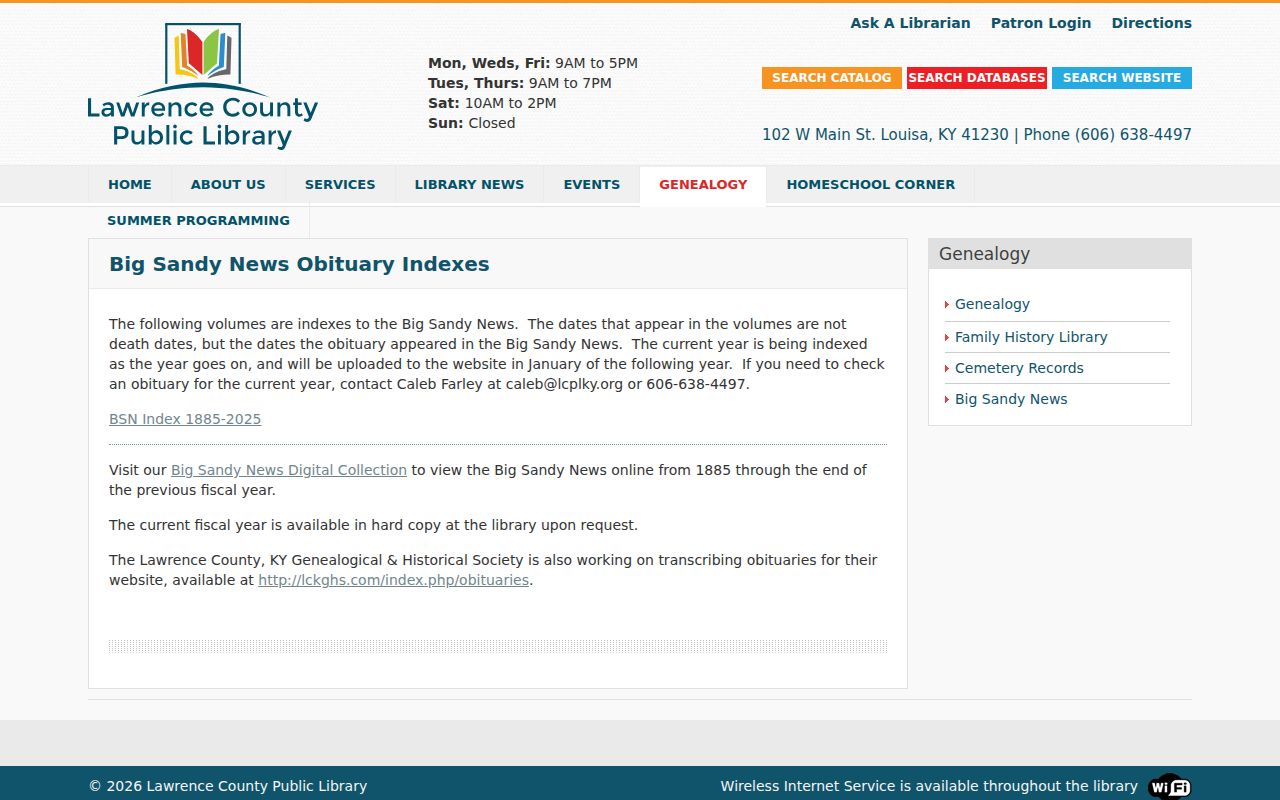
Treat a newspaper name or date as a lead only. Then confirm the transfer in the deed book, probate file, or tax record.
Lawrence County Ownership Before 1822
Lawrence County won approval in 1821. It was carved from Greenup and Floyd Counties. The new county stood on its own by 1822. So an ownership chain reaching back before that year may need work in the predecessor counties. No courthouse fire or destroyed deed-book decade appears in the county's own published history. The recorder publishes no record naming the first Lawrence deed book. Treat any gap as an index, spelling, fiduciary, jurisdiction, or repository problem first. Only then consider it a true record loss.
Lawful use. Research prior owners for title, house history, estates, minerals, or purchase diligence. Never use property records to monitor, threaten, or harass a living person.