
Build a Lawrence County Property Search
Lawrence County publishes no online PVA search form and no deed index. There is no tax-bill portal and no parcel viewer either. Order therefore matters. Begin with the Lawrence County PVA. That office keeps the assessment roll and the current owner-of-record lead. Ask staff to match the address or name you have. They can return the exact map or parcel number. That single identifier then bridges the property search to the County Clerk, the tax collector, and map material. Without it, every later step slows down. With it, a deed records request or tax bill lookup moves quickly from office to office.
- Write the full street address as observed, including road prefix, suffix, community name, and ZIP.
- Call or visit the PVA and request the owner of record, situs, mailing address, map or parcel number, value, exemption, and source deed.
- Carry the recorded owner name and source-deed reference to the Lawrence County Clerk for the acquisition deed and related instruments.
- Check current tax status with the Sheriff and delinquent status with the County Clerk, using the same parcel reference.
- Use state GIS layers, a recorded plat, and any PVA map for orientation, while treating a survey as the boundary authority.
A failed lookup rarely means the property or transfer is missing. The trouble may be a road-name variant, an estate or trust name, an older community label, or simply an offline index. Recheck the spelling, then try the counter.
Request Lawrence County PVA Search Fields
The Lawrence County PVA is Chris A. Rose, working from the courthouse at 122 South Main Cross Street in Louisa. The published phone number is (606) 638-4743, and the state directory lists weekday hours from 8:00 a.m. to 4:00 p.m. Since the county offers no public search interface, phone and counter are the access channels. Be specific about the fields you need. Asking only for "the property record" invites a vague answer, while naming the parcel, owner of record, or appraisal detail you want gets a precise one from the assessor's staff.
| Request Field | Why It Matters | Local Status |
|---|---|---|
| Owner of record | Names the party carried on the assessment roll | Request from PVA |
| Situs and mailing addresses | Separates the land location from the tax-notice address | Request both |
| Map or parcel number | Provides the most exact cross-office key | Exact format not published |
| Land, improvement, and total values | Shows the parts of the current assessment | Request with assessment year |
| Class and exemption | Explains agricultural or homestead treatment | Request current status |
| Last transfer or source deed | Points to the recorded instrument | Local display not verified |
The official Kentucky PVA directory supplies the office contact, not a parcel result. When an exact field value will feed further research, ask for a printout or written confirmation.
Lawrence County's Missing Search Portal
The missing portal is a practical fact, not a dead end. Resist substituting a web result from a different state's Lawrence County. For ownership and appraisal questions, call the PVA or visit the courthouse counter. Deeds, mortgages, releases, liens, plats, and leases are a different matter. Go to the Lawrence County Clerk's land-record counter for those. Neither counter may produce the record. The Kentucky Open Records Act then opens a written-request route to the deed records and tax material a search box never would.
Counter first. A direct PVA or Clerk request is more reliable here than an unverified third-party index with an unclear county and update date.
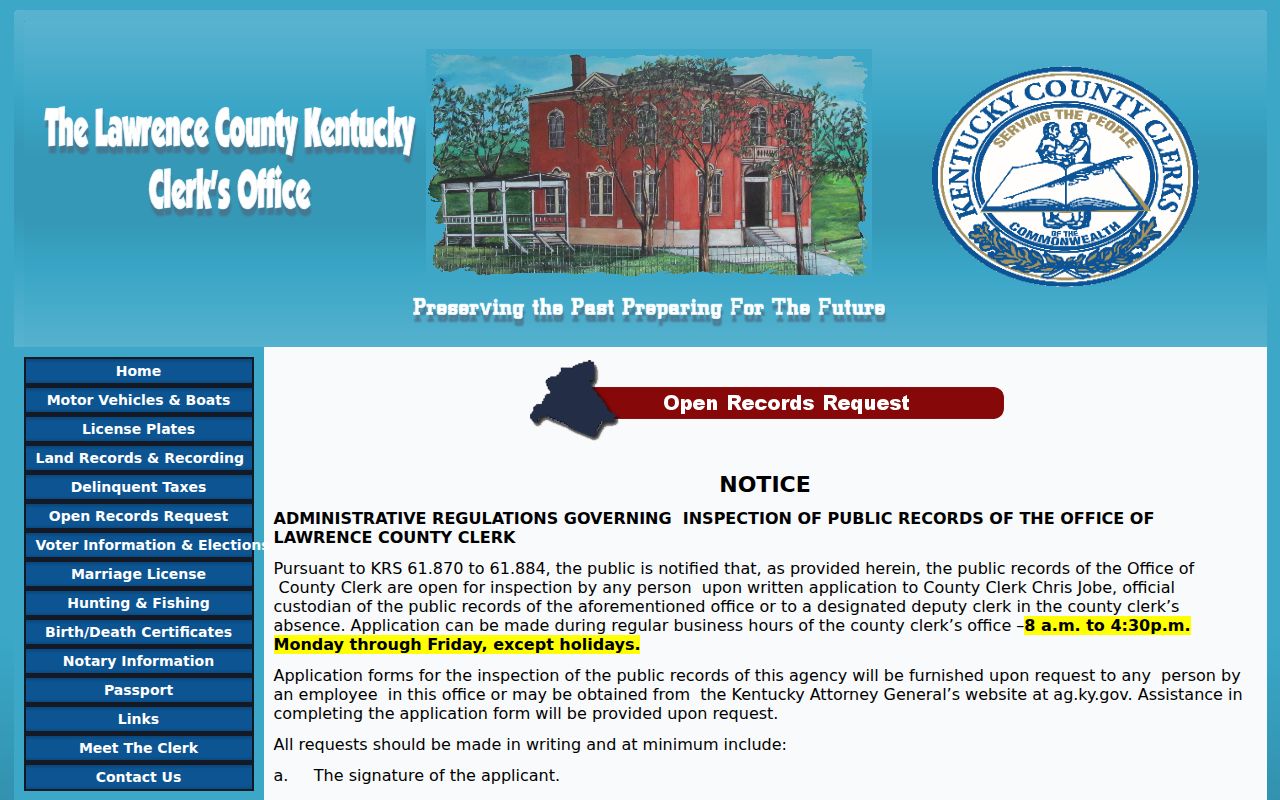
The Clerk's open-records instructions require a signed request with a printed name. The request needs a clear description of the record, a residency statement, and a commercial-use statement. An address is needed when copies are wanted. The office gives notice within five working days. That applies if a record is unavailable or access is denied.
Inspection is free. Noncommercial written copies run ten cents per page, with postage added on. The Clerk's request page displays the form and instructions that matter. It serves whenever a property search reaches an offline index, a historic tax list, a plat, or another record no public search box can produce.
Narrow the request with the parcel number, owner names, a date range, the record type, and the format you want. A precise ask cuts the risk of a no-result.
Capture Lawrence County Property Results
No local parcel card is publicly viewable online, so the PVA must confirm exact labels. Even so, a sound Lawrence County property search should capture every field that follows. Keeping the values together prevents confusion. A mailing address, an owner name, or an appraisal figure can each be mistaken for something it is not. Deed records, not the parcel card, carry the legal description.
| Owner of record | The name or names carried on the current assessment roll |
|---|---|
| Situs and mailing address | The parcel's physical location and the separate address used for notices |
| Parcel number or APN | The map-based identifier used to align records for one tract |
| Assessment | Land, improvement, and total fair-cash value for a stated year |
| Legal description | Lot, block, boundary calls, acreage, or parent-tract language tied to title |
| Transfer clue | Sale date, consideration, and book/page or instrument reference if maintained |
"Parcel number" and "APN" are broad labels for the local assessment identifier. Lawrence County's exact punctuation and prefix scheme is unpublished. "Situs" simply means the physical property location. "Owner of record" is the name on the assessment roll. It can lag behind a recent closing. None of these fields replaces the legal description in a deed. Nor does it replace a licensed boundary survey.
Lawrence County Address Search Limits
A street address is a locate clue. A legal description identifies the land conveyed. Older Lawrence County deeds may rely on a branch, creek, ridge, road, fork, or parent tract. They may cite a parent tract instead of a modern house number. Community names such as Meadowbrook, Blaine, Fallsburg, Meades Branch, Brammer Gap, and Webbville stay useful. None of them is an incorporated city. Mailing city, ZIP geography, precinct, and municipal limits are separate systems that answer separate questions. Louisa annexation filings along Lick Creek, the Levisa Fork, KY 644, KY 3, and US 23 show why an old county-community description may not match a current mailing label. Preserve the deed's exact wording. Then ask the PVA to cross-reference it to the present parcel number on the tax roll. Note: USPS delivery data, a PVA situs, and a certified city boundary each answer a different question and need not match word for word.
Choose a Lawrence County Search Key
Each key answers a different part of a Lawrence County property search. An address is usually fastest for one known site. An owner name can surface several parcels, though entity and fiduciary names complicate it. The parcel number is the cleanest handoff between offices. The PVA supplies the exact local form.
| Search Key | Best For | Where It Works | Watch Out |
|---|---|---|---|
| Address | Locating one known property | PVA request; map context | Road variants, rural routes, and readdressing |
| Owner name | Finding holdings tied to a party | PVA roll; Clerk index | Trusts, entities, estates, and same names |
| Parcel number | Matching the exact assessment unit | PVA, tax, and map requests | Format may differ from deed references |
Not a title search. A Lawrence County property search assembles public-record clues but does not guarantee ownership, priority, clear title, or a surveyed boundary.
Search Lawrence County Entity Owners
Exact legal spelling wins owner searches. An LLC should be confirmed in the Kentucky Secretary of State business search first. Then enter it in the Clerk's index under that precise entity name. Trusts need both the trust name and every trustee spelling the deed shows. Estate transfers may be indexed under a decedent, executor, administrator, heirs, commissioner, or sheriff.
Same-name owners call for a second look. Compare middle initials, co-owners, mailing addresses, legal descriptions, and book/page references. A homestead classification describes tax treatment only. It does not prove occupancy or settle title. An ordinary surname may fail. The Kentucky Department for Libraries and Archives deed guide suggests testing fiduciary index entries such as heirs, commissioner, and sheriff.
A small name log pays off as the search develops. Record the exact PVA spelling. Note every deed spelling, the role beside each name, and the years each party appears. Search a married or inherited interest only from recorded clues. An entity may have changed names. Keep both forms and connect them through an official business filing before treating them as one owner.
Carry Lawrence Parcel Keys Across Records
The County Clerk does not organize deeds by street address. Start with the PVA's owner and map/parcel clue. Then request the acquisition deed from the Clerk. Read the grantee, grantor, and recording date. Note the instrument type, book/page or instrument number, and legal description. Also read the consideration statement and source-of-title reference. The full path for pulling one instrument appears on the Lawrence County deed records page.
Next, compare the parcel with current Sheriff tax status and any County Clerk delinquent certificate. State map services such as KYGeoNet, KYGovMaps, and KGSGeoPortal add road, aerial, terrain, and environmental context. These statewide services publish no Lawrence owner-parcel layer or adjacent-parcel tool, though. A recorded plat or survey still beats a web map for a disputed line.
Keep an audit row for each source: office, date checked, search key, result, and next citation. That habit matters in Lawrence County. The assessment, deed, tax, and statewide map layers share no single public interface. It also reveals whether a mismatch stems from an update lag. It may stem from a formatting change, or a truly different tract.
Confirm Lawrence County Property Transfers
Kentucky assessments are keyed to January 1. A PVA owner name may lag behind a recent closing. The recorded deed confirms a just-completed transfer far better. Lawrence County Clerk Chris Jobe records deeds and related land instruments at 122 South Main Cross Street in Louisa. General weekday hours are 8:30 a.m. to 4:30 p.m. There is also a first-Saturday session from 8:30 a.m. to noon.
The Clerk's official land-record page documents the recording function. It posts no public county deed-search form or cutoff year. Ask for the grantor/grantee index. Cite the owner names, the approximate recording date, and any PVA source-deed reference. If the latest deed names a life estate or remainder interest, read the instrument itself. Do not reduce it to one "owner" field.
A fresh conveyance often leaves related filings behind. Ask whether a mortgage, release, affidavit, power of attorney, or plat was recorded around the same time. Compare the deed's return address and legal description with the PVA result. Neither proves the physical boundary. For a purchase, estate, or mineral question, a Kentucky attorney or qualified title professional can evaluate the full chain. That review also covers any interest the index does not plainly show.